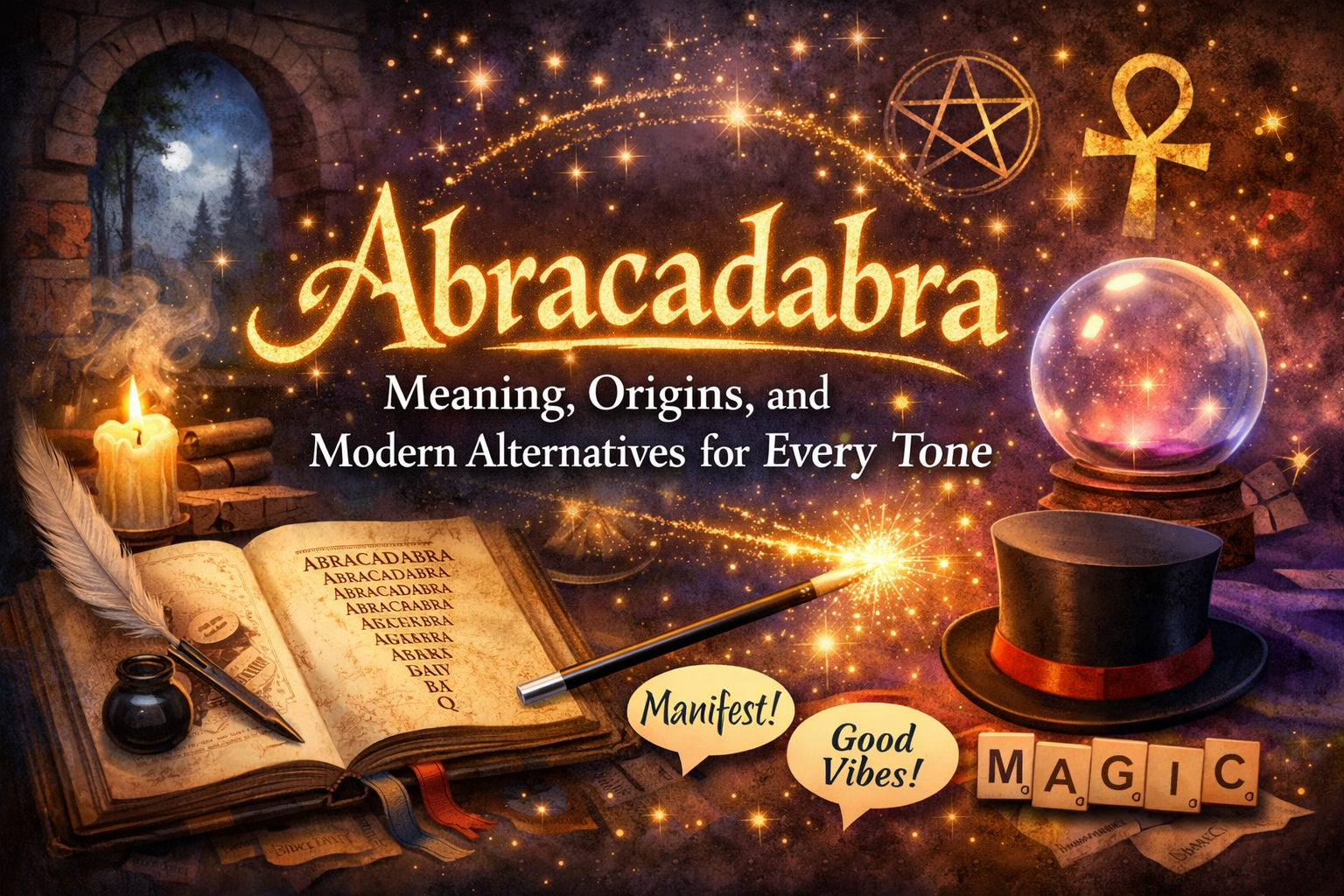
Abracadabra is one of those words everyone recognizes instantly. You’ve heard it in magic shows, cartoons, jokes, and everyday conversation. It sounds playful. Almost silly. Yet behind that familiar sound sits a long, serious, and fascinating history.
The meaning of abracadabra didn’t begin on a stage or in a children’s book. It started as a word people believed could heal illness, protect the body, and influence unseen forces. Over centuries, its purpose shifted. What once functioned as a sacred charm slowly turned into a symbol of instant change and theatrical magic.
This article explores the true meaning of abracadabra, its origins, how its meaning evolved, and the best modern alternatives you can use today depending on tone and context.
Why Abracadabra Still Matters Today
Even in a world driven by science and technology, abracadabra hasn’t disappeared. People still search for its meaning, writers still use it metaphorically, and entertainers rely on it for dramatic flair.
That staying power exists because abracadabra represents something deeply human:
- The desire for instant transformation
- The appeal of mystery
- The joy of playful imagination
Understanding abracadabra means understanding how language evolves without losing emotional impact.
What Does Abracadabra Mean?
In modern English, abracadabra means a spoken word or phrase that signals a sudden or seemingly magical change.
People use it to suggest:
- Something happened instantly
- A result appeared without visible effort
- A transformation feels almost unreal
The word no longer claims supernatural power. Instead, it works as a metaphor for speed, surprise, or illusion.
Simple definition
Abracadabra: a word used to express sudden change, magical effect, or playful transformation.
Everyday usage examples
- “They expect success to happen by abracadabra, but real growth takes time.”
- “With a few clicks—abracadabra—the file was restored.”
- “The magician whispered abracadabra, and the crowd leaned forward.”
Each example uses abracadabra to signal a shift, not a spell.
The Origin of Abracadabra
The origin of abracadabra traces back nearly two thousand years. It appears long before modern magic shows or entertainment.
The earliest historical record
The first known written mention appears in the 2nd century CE in Liber Medicinalis, a medical text by the Roman physician Quintus Serenus Sammonicus. He prescribed abracadabra as a healing charm, not a joke.
Patients were instructed to write the word in a triangular pattern and wear it as an amulet to cure illness, especially fevers.
Competing origin theories
Scholars still debate where the word truly comes from. The most accepted theories include:
- Aramaic theory: From the phrase avra kehdabra, meaning “I create as I speak”
- Hebrew theory: Linked to words associated with blessing or divine power
- Greek theory: Possibly derived from abrasax, a mystical term connected to Gnostic traditions
No single theory has been universally proven. Still, all agree abracadabra held serious spiritual meaning in its earliest uses.
Abracadabra in Ancient Medicine and Mysticism
Long before stage magicians, abracadabra functioned as a protective and medicinal charm.
How it was used
Patients were told to write the word repeatedly, removing one letter per line, forming an inverted triangle:
- ABRACADABRA
- ABRACADABR
- ABRACADAB
- ABRACADA
- ABRACAD
- ABRACA
- ABRAC
- ABRA
- ABR
- AB
- A
The belief was simple yet powerful. As the word shrank, the illness weakened and eventually disappeared.
Why people believed it worked
In ancient cultures, words held power. Spoken language was thought to shape reality. Writing abracadabra symbolized control over chaos, illness, and fear.
This wasn’t superstition alone. It reflected how people understood health before modern medicine.
How Abracadabra Entered Pop Culture
Abracadabra didn’t become playful overnight. Its transformation happened gradually.
From sacred to theatrical
By the 18th and 19th centuries, public interest in magic shifted from mysticism to entertainment. Stage performers adopted mysterious words to enhance drama. Abracadabra fit perfectly.
It sounded exotic.
It felt ancient.
It was easy to remember.
Soon, abracadabra became shorthand for illusion, not belief.
Popular culture influence
Abracadabra spread through:
- Traveling magic shows
- Children’s literature
- Early cartoons and radio
- Television and movies
By the 20th century, its meaning had fully shifted into the playful realm.
What Abracadabra Symbolizes Today
Today, abracadabra symbolizes instant transformation without explanation.
It often conveys:
- Humor
- Sarcasm
- Wonder
- Nostalgia
People use it to soften claims, mock unrealistic expectations, or add flair to storytelling.
Emotional tone
Abracadabra feels:
- Lighthearted
- Non-threatening
- Slightly ironic
That tone explains why it still works in modern language.
Read More”Growler Meaning: What the Term Really Means and When to Use Better Alternatives
Modern Alternatives to Abracadabra (By Tone and Context)
While abracadabra remains recognizable, it doesn’t fit every situation. Tone matters.
Playful and lighthearted alternatives
- “Ta-da!” – Perfect for reveals
- “Poof!” – Emphasizes disappearance
- “Presto!” – Classic and upbeat
- “Voilà!” – Polished and cheerful
These work well in casual speech, presentations, and creative writing.
Funny or sarcastic alternatives
- “And just like that…”
- “Magic, apparently”
- “Because reasons”
- “Problem solved”
These phrases add humor without sounding childish.
Professional or neutral alternatives
- “Instantly”
- “With immediate effect”
- “Seamlessly”
- “Effortlessly”
Use these in business writing or formal communication.
Dramatic or storytelling alternatives
- “In the blink of an eye”
- “Suddenly, everything changed”
- “As if fate intervened”
- “Without warning”
These add depth and tension to narratives.
Abracadabra vs Similar Magic Words
| Word | Core Meaning | Tone | Common Use |
| Abracadabra | Magical transformation | Playful | Magic, humor |
| Presto | Quick result | Light | Performance |
| Voilà | Reveal | Polished | Presentations |
| Alakazam | Surprise | Comic | Cartoons |
Each word creates a different emotional effect.
Is Abracadabra Still Relevant in Modern Language?
Yes. Abracadabra survives because it fills a specific linguistic role. It expresses instant change with emotional warmth.
People still search for the meaning of abracadabra because:
- It appears in pop culture
- Writers use it metaphorically
- Parents explain it to children
- Speakers use it humorously
Language doesn’t discard words that still connect emotionally.
When You Should and Shouldn’t Use Abracadabra
When it works
- Informal writing
- Creative storytelling
- Humor and satire
- Teaching metaphors
When it doesn’t
- Legal documents
- Technical explanations
- Serious academic work
- Professional reports
Choosing the right word shows awareness, not intelligence.
Why People Still Search “Abracadabra Meaning”
Search intent usually falls into three categories:
- Curiosity about origin
- Understanding metaphorical use
- Writing clarity
Articles that explain context, not just definitions, outperform basic dictionary entries.
Conclusion
Abracadabra started as a healing charm, evolved into a symbol of illusion, and now lives as a playful metaphor for instant change.
Its meaning matters because language carries history. When you use abracadabra—or one of its modern alternatives—you tap into centuries of human belief, creativity, and imagination.
Choose your words wisely. Magic, after all, lives in how you say things.
FAQs
What language does abracadabra come from?
Its origin is debated, with roots possibly in Aramaic, Hebrew, or Greek.
Is abracadabra a real word?
Yes. It has appeared in written texts for nearly 2,000 years.
Can abracadabra be used seriously?
Rarely. Today, it works best in playful or metaphorical contexts.
What is a modern replacement for abracadabra?
Options include “instantly,” “ta-da,” or “in the blink of an eye,” depending on tone.
Why do magicians still say abracadabra?
Because it instantly signals mystery, tradition, and transformation.

Sophia adds humor and confidence to Captioniy.com. Her witty Instagram captions and bold quotes help readers make their posts stand out.