If you’ve ever described a rule as draconian, you probably meant it felt extreme or unfair. Maybe it was a strict workplace policy. Maybe it was a school rule that seemed wildly out of proportion. The word carries weight. It doesn’t just mean “strict.” It signals something harsher. Something excessive.
Still, many people use the term without fully understanding the true draconian meaning. They know it sounds serious. They sense it implies severity. But few realize the word traces back more than 2,600 years to ancient Greece. Fewer still understand how its historical roots shape its modern tone in politics, business, and everyday conversations.
In this guide, you’ll discover exactly what draconian means, where it comes from, and how to use it correctly in text, professional writing, and casual speech. You’ll also learn when to avoid it and what alternatives work better. Clear explanations. Real examples.
Draconian Meaning: Clear Definition in Simple Words
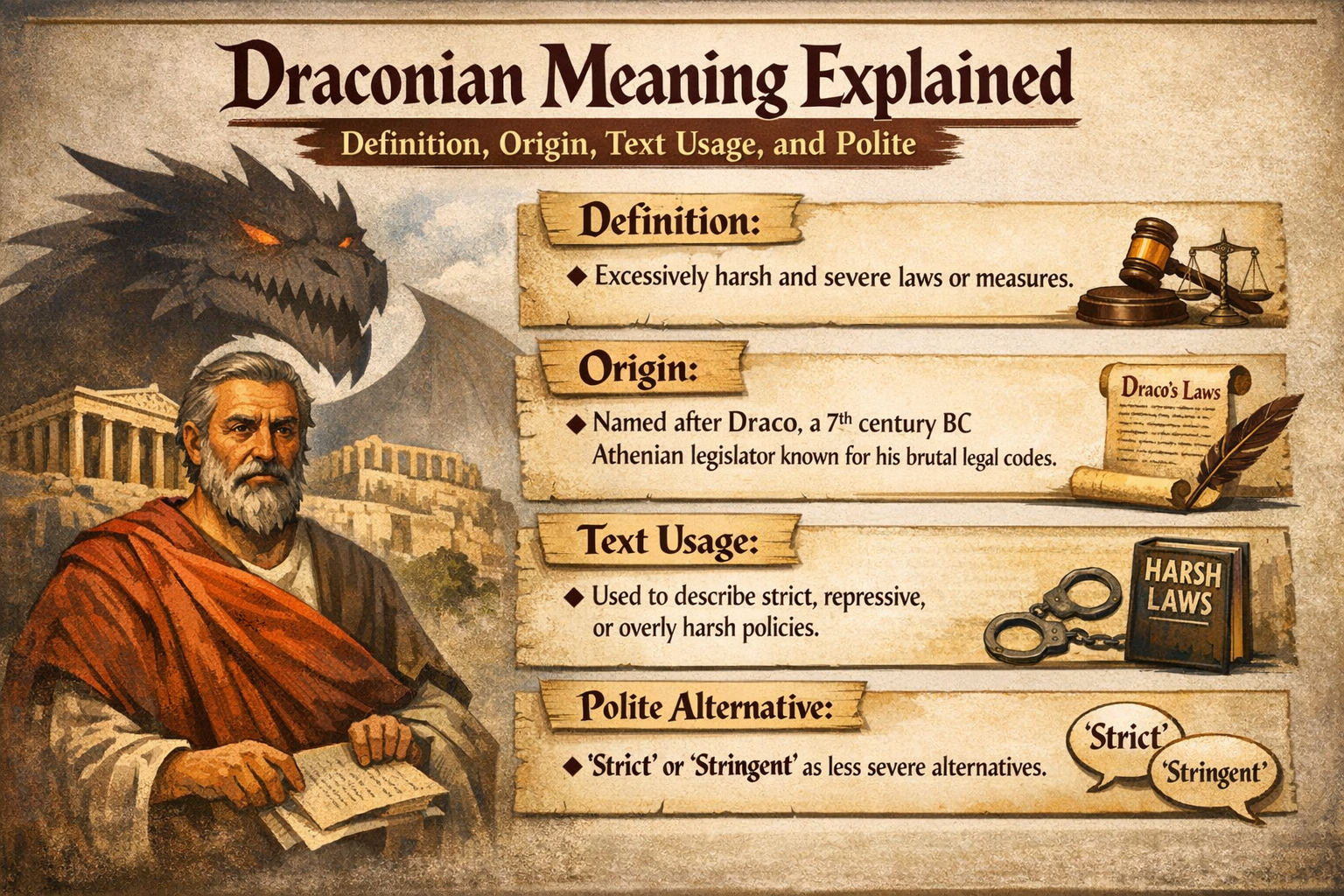
At its core, draconian describes something excessively harsh or severe, especially laws or punishments.
Dictionary Definition
Major dictionaries define it this way:
Draconian (adjective): Extremely severe or harsh, especially in enforcing rules or punishments.
Two ideas sit at the center:
- Severity
- Excessiveness
That second word matters. A rule can be strict. It becomes draconian when it feels disproportionate.
Plain English Explanation
Imagine a school suspending a student for forgetting homework once.
That’s not just strict. That’s draconian.
Or picture a company firing employees for being five minutes late.
Again, that’s not ordinary discipline. It’s excessive enforcement.
Pronunciation Guide
- Phonetic: druh-KOH-nee-uhn
- Sounds like: “druh-cone-ee-uhn”
Common mistake? Saying “dray-cone-ian.” That’s incorrect.
The Origin of Draconian Meaning: Who Was Draco?
To understand the word, you need to travel back to ancient Athens.
Who Was Draco?
Draco was a lawmaker in Athens around 621 BCE. Before his reforms, laws were mostly oral and inconsistently enforced.
Draco changed that.
He created one of the first written legal codes in Athens.
That sounds progressive. It was. But there was a problem.
Why Were His Laws Considered Harsh?
Draco’s punishments were extreme.
Historical sources report that even minor crimes carried the death penalty.
Stealing food? Death.
Petty theft? Death.
Small offenses? Death.
When asked why penalties were so severe, Draco allegedly said smaller crimes deserved death and he had no harsher penalty for greater ones.
That statement alone explains why his name became synonymous with cruelty.
Historical Context Matters
At the time, written law was revolutionary. It reduced arbitrary decisions by elites.
However, the punishments were so unforgiving that later Athenian leader Solon replaced most of them.
Today, when we call a policy draconian, we’re referencing this ancient system.
That’s powerful history packed into one adjective.
Does “Draconian” Stand For Anything?
No. It’s not an acronym.
It doesn’t stand for a phrase. It’s derived directly from the name Draco.
Some people assume it might be like “NASA” or “SCUBA.” It isn’t.
It’s simply an adjective formed from a proper name.
Draconian Meaning in Text and Modern Usage
You’ll often see the word in news headlines, opinion pieces, and political debates.
In Government and Politics
Journalists frequently describe strict legislation as draconian.
For example:
- Travel bans
- Heavy surveillance laws
- Severe immigration penalties
- Harsh tax enforcement
The word implies more than strictness. It suggests injustice or overreach.
In Business and Workplace Settings
In corporate environments, you might hear:
- “The company implemented draconian attendance policies.”
- “Management introduced draconian budget cuts.”
Here, the speaker signals frustration and believes the policy goes too far.
In Everyday Conversations
In casual speech, the tone softens.
Examples:
- “My parents had draconian curfews.”
- “That gym has draconian cancellation fees.”
Notice something? In daily life, the word often exaggerates for emphasis.
Is Draconian Always Negative?
Almost always.
The term carries strong criticism. It suggests:
- Excessive control
- Lack of fairness
- Disproportionate punishment
It rarely sounds neutral.
Using it in professional communication can escalate tension.
Choose carefully.
Draconian vs Similar Words: Key Differences
Here’s a quick comparison.
| Word | Core Meaning | Severity Level | Implies Excess? |
| Strict | Firm enforcement | Moderate | No |
| Severe | Intense or serious | High | Not always |
| Harsh | Rough or unpleasant | Moderate | Sometimes |
| Stringent | Very strict | High | No |
| Draconian | Excessively harsh | Very High | Yes |
The key difference?
Draconian implies unfair excess.
Real-World Examples of Draconian in Sentences
Let’s ground this in reality.
News Example
“The legislation imposes draconian penalties on small business owners.”
The implication? Lawmakers went too far.
Workplace Example
“The new compliance rules feel draconian.”
This signals dissatisfaction and possible resistance.
Casual Example
“That teacher’s grading policy is draconian.”
Likely exaggeration. Still expressive.
Polite Alternatives to Draconian
If you want to stay diplomatic, tone it down.
Here are respectful substitutes:
- Stringent
- Strict
- Rigorous
- Highly restrictive
- Firmly enforced
- Demanding
Before and After
Instead of:
“Your policy is draconian.”
Try:
“Your policy feels highly restrictive.”
See the difference? One attacks. The other opens discussion.
Professional Alternatives for Workplace Communication
In formal writing, precision matters.
Use these instead:
- Excessively restrictive
- Disproportionate
- Overly punitive
- Unduly harsh
- Severe enforcement framework
Example Rewrite
Original:
“The disciplinary system is draconian.”
Professional:
“The disciplinary system may be overly punitive relative to the infraction.”
Notice how it shifts from emotional to analytical.
That’s powerful.
Casual Alternatives for Texting and Everyday Talk
In relaxed settings, simpler language works better.
Try:
- Too strict
- Way over the top
- Super harsh
- Ridiculous
- Extreme
Example:
Instead of:
“That rule is draconian.”
Say:
“That rule is way over the top.”
It feels natural. It connects.
When NOT to Use Draconian
Even strong words have limits.
Avoid it when:
- You’re negotiating contracts.
- You’re giving formal feedback.
- You’re addressing cultural differences.
- You want collaboration.
Ask yourself:
Is this rule truly excessive?
Or am I just frustrated?
That quick pause can save relationships.
Common Mistakes with Draconian Meaning
Thinking It’s an Acronym
It isn’t. It comes from Draco’s name.
Using It for Minor Annoyances
Slow Wi-Fi isn’t draconian.
That’s inconvenience. Big difference.
Confusing It with “Tyrannical”
“Tyrannical” implies abusive leadership.
“Draconian” focuses on harsh rules.
Subtle distinction. Important nuance.
Case Study: Workplace Tone Shift
Scenario
A company introduces a zero-tolerance tardiness policy.
Version One
“Management’s draconian rules are destroying morale.”
Emotional. Confrontational.
Version Two
“The new attendance policy may be overly strict and could impact morale.”
Measured. Strategic.
The second version invites dialogue.
The first creates defensiveness.
Language shapes outcomes.
Case Study: Parent-Teen Communication
Teen says:
“Your curfew is draconian!”
Parent hears accusation.
Alternative:
“The curfew feels really strict compared to my friends’.”
Now the conversation opens.
Same frustration. Different energy.
Read More: Overstimulated Meaning & Hiatus Meaning
Quick Reference Summary
Meaning in one sentence:
Draconian describes rules or punishments that are excessively harsh and often unfair.
Origin:
Named after Draco, the ancient Athenian lawmaker known for severe penalties.
Best professional alternative:
Disproportionate or overly punitive.
Best casual alternative:
Way over the top.
Why Draconian Meaning Still Matters Today
Language evolves. Yet this word survived over 2,600 years.
Why?
Because societies still debate power, fairness, and punishment.
From government lockdowns to corporate policies, accusations of draconian measures appear whenever authority tightens control.
The word carries moral weight.
It signals that enforcement crossed into excess.
That’s not a small claim.
How to Decide If Something Is Truly Draconian
Use this checklist:
- Is the punishment extreme relative to the offense?
- Does it eliminate reasonable flexibility?
- Does it create fear rather than order?
- Is there public backlash?
If you answer yes to most, the label may fit.
If not, consider softer wording.
Expert Insight on Language and Tone
Communication experts often stress that emotionally charged words escalate conflict.
Research from Harvard’s Program on Negotiation shows that reframing language increases agreement rates in disputes.
Instead of labeling a policy draconian, describing specific impacts produces better outcomes.
Facts persuade. Labels inflame.
Draconian Meaning in Academic and Legal Writing
In academic contexts, the term appears in political science and legal theory.
However, scholars usually pair it with evidence.
For example:
“The statute imposed draconian sentencing guidelines that disproportionately affected low-income defendants.”
Notice the data focus.
That’s how professionals use the word responsibly.
Conclusion
Words shape perception. Few words carry the historical and emotional weight that draconian does. It doesn’t simply describe strict rules. It signals excessive severity, often paired with unfairness or disproportionate punishment. When you use it, you’re not just commenting on policy. You’re making a strong judgment about balance and justice.
Understanding the full draconian meaning helps you communicate with precision. In politics, it can spotlight overreach. In business, it can challenge rigid enforcement. In everyday conversations, it can express frustration with impact. However, because the word feels intense, you should use it carefully. Sometimes “stringent” or “overly restrictive” communicates your point more effectively without escalating tension.
FAQs
What is the exact draconian meaning?
The word draconian means excessively harsh or severe, especially when describing laws, rules, or punishments. It goes beyond ordinary strictness. When something is draconian, it feels extreme and often disproportionate to the situation.
For example, suspending a student for a minor mistake could be described as draconian because the punishment outweighs the offense.
Is draconian always negative?
Yes, almost always.
The term carries a critical tone. When you call something draconian, you imply that it is unreasonably harsh or unfair. It rarely sounds neutral. In professional settings, the word can feel confrontational, so choose it carefully.
Where does the word draconian come from?
The word comes from Draco, an ancient Athenian lawmaker from around 621 BCE. He created one of the earliest written legal codes in Athens. His laws imposed extremely severe punishments, including the death penalty for minor crimes.
Because of that severity, his name became associated with harsh legal systems. Over time, “draconian” entered English to describe excessively strict rules.

Daniel believes in the power of simplicity. At Captioniy.com, he writes short and clear Instagram captions that are easy to share and always impactful.