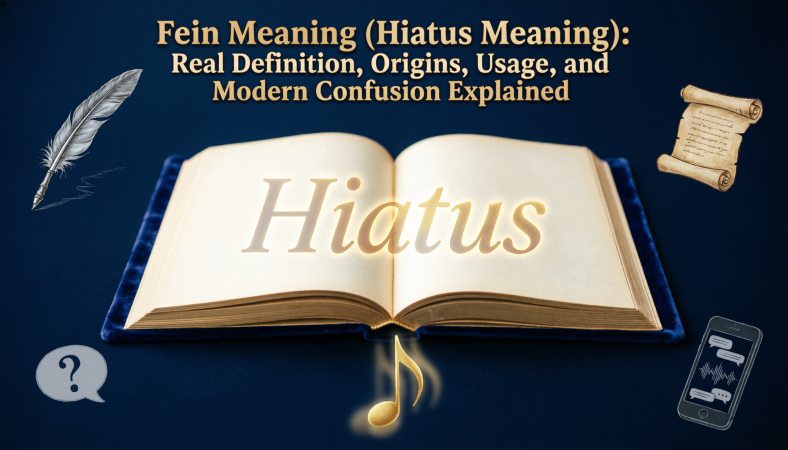
You’ve probably seen the word “fein” pop up in captions, lyrics, or comments and wondered what it actually means. Is it slang? Is it a typo? Or is it a new word that somehow slipped into modern English? That curiosity drives thousands of searches for Fein meaning (Hiatus meaning) every month. People want clarity. And honestly, the confusion makes sense.
Here’s the reality. “Fein” isn’t a standard English word. Most of the time, it’s a phonetic spelling of “fiend,” a real word with deep historical roots. Over time, “fiend” shifted from meaning a demon or enemy to describing someone who’s intensely passionate or even obsessed with something. Meanwhile, “hiatus” lives in a completely different lane. It simply means a temporary pause or break. Yet search trends often link them together, which adds to the misunderstanding.
Language evolves quickly, especially online. Slang spreads fast, spelling bends to sound, and meanings shift with culture. If you don’t slow down and examine the details, it’s easy to mix things up. This guide clears the fog. You’ll understand what “fein” really means, when to use “fiend” instead, and why “hiatus” has nothing to do with either. Once you see the difference, the confusion disappears.
Fein Meaning: Is “Fein” Even a Real Word?
Here’s the direct answer.
“Fein” is not a standard English word.
Major dictionaries such as and do not list “fein” as a standalone English word with the meaning people commonly intend.
So what’s going on?
In most cases, “fein” is a misspelling or slang variation of “fiend.”
That’s it.
However, language doesn’t live only in dictionaries. It lives in:
- Music
- Street slang
- Social media
- Meme culture
- Text messages
And that’s where “fein” gained momentum.
Fein Meaning vs Fiend Meaning: The Core Difference
Let’s break this down clearly.
| Term | Official Word? | Core Meaning | Common Usage |
| Fein | No | Slang misspelling | Online slang |
| Fiend | Yes | Originally a demon; now someone obsessed | Standard English |
When people write:
“He’s a sneaker fein.”
They usually mean:
“He’s a sneaker fiend.”
The word “fiend” has a long and fascinating history. “Fein” simply mirrors how it sounds.
Pronunciation drives spelling more than you think. English speakers often write words the way they hear them. That phonetic habit fuels many slang spellings.
What Does “Fiend” Actually Mean? (The Word Behind Fein Meaning)
To understand Fein meaning, you need to understand fiend meaning.
Historical Meaning
The word “fiend” comes from Old English fēond, meaning:
- Enemy
- Devil
- Demon
Back then, it had a dark, almost supernatural tone.
Modern Meaning
Over time, the meaning softened. Today, “fiend” usually describes:
- Someone extremely passionate
- Someone obsessed
- Someone addicted to something
For example:
- She’s a chocolate fiend.
- He’s a fitness fiend.
- They’re horror movie fiends.
No demons involved. Just intense enthusiasm.
Language evolves. Meaning shifts. Tone softens. That’s semantic drift in action.
Why Did “Fein” Become Popular?
So if “fiend” already exists, why did people start writing “fein”?
Three major reasons explain it.
Phonetic Spelling
“Fiend” sounds like “feen.”
People hear the word. They spell it the way it sounds. Simple.
Social Media Acceleration
Short-form platforms reward speed over spelling accuracy. When slang spreads, it spreads fast.
Misspellings often stick because:
- They look cooler.
- They feel less formal.
- They match the vibe of casual speech.
Music and Pop Culture Influence
Hip-hop culture has played a strong role in reshaping spelling norms. Artists often tweak spelling for:
- Flow
- Rhythm
- Branding
- Style
When a lyric writes “fein,” fans repeat it. Repetition builds acceptance.
Real Usage Examples of Fein Meaning in Modern Slang
Let’s look at real-life scenarios.
In Casual Conversation
- “I’m a caffeine fein.”
- “He’s a gym fein.”
- “She’s a shopping fein.”
In Text Messages
“Bro I’m a sneaker fein fr.”
On Social Media
Captions often drop traditional spelling rules. That’s intentional. It signals tone and identity.
However, in professional writing, using “fein” instead of “fiend” can weaken credibility.
Context matters.
When You Should Use “Fiend” Instead of “Fein”
If you’re writing:
- Academic essays
- Business emails
- Blog posts
- Journalism
- Professional content
Use fiend.
Never use “fein” in formal settings.
Why?
Because clarity builds authority. Precision builds trust.
Here’s a quick comparison:
| Context | Use “Fiend”? | Use “Fein”? |
| Academic Paper | Yes | No |
| Business Email | Yes | No |
| Text Message | Optional | Yes |
| Rap Lyrics | Optional | Yes |
| Blog Writing | Yes | No |
Read More: Mucho Gusto Meaning: The Complete Guide to Spanish Greetings and Their English Equivalents
Hiatus Meaning: A Completely Different Word
Now let’s address the second part of the keyword: Hiatus meaning.
Many people search “Fein meaning (Hiatus meaning)” together because both terms trend at the same time. However, they are completely unrelated words.
What Does “Hiatus” Mean?
A hiatus is:
A temporary pause or break in activity.
That’s it.
It does not mean obsession. It does not relate to addiction.
It means pause.
Real-Life Examples of Hiatus
- A TV show goes on hiatus between seasons.
- A band announces a touring hiatus.
- A content creator takes a social media hiatus.
Hiatus Usage Table
| Word | Part of Speech | Meaning | Example |
| Hiatus | Noun | Temporary pause | The podcast is on hiatus. |
| Fiend | Noun | Obsessed person | He’s a tech fiend. |
| Fein | Slang | Misspelling of fiend | Informal only |
Why Do People Search Fein Meaning and Hiatus Meaning Together?
Search behavior reveals patterns.
When trending lyrics or captions combine slang with formal terms, users search both meanings at once.
Other reasons include:
- Misheard lyrics
- Auto-generated captions
- SEO blending
- Curiosity spikes
Search engines track what people type, not what they intend.
Deep Linguistic Insight: How Slang Misspellings Go Mainstream
Let’s zoom out.
English absorbs slang constantly. Some misspellings fade. Others survive.
Here’s how it usually happens:
- A word gets used informally.
- Someone spells it phonetically.
- Influencers repeat it.
- It spreads through music or memes.
- It stabilizes as accepted slang.
Not all slang becomes standard English. Most never enter formal dictionaries.
However, they still shape culture.
Case Study: The Evolution of “Fiend” from Demon to Enthusiast
Language historians note that many English words soften over time.
Take “fiend.”
Originally:
- Associated with evil
- Connected to religious narratives
- Symbol of danger
Now:
- Harmless descriptor
- Often playful
- Used positively
Example:
“She’s a math fiend.”
That’s not an insult. It’s admiration.
This shift shows how society reframes intensity.
Alternatives to “Fiend” (If You Want Cleaner Language)
Sometimes “fiend” sounds too dramatic. You may want softer words.
Here are strong alternatives:
Neutral Tone
- Enthusiast
- Fan
- Devotee
- Supporter
Casual Tone
- Buff
- Junkie
- Lover
- Addict
Professional Tone
- Specialist
- Advocate
- Aficionado
Replacement Chart
| Informal | Neutral | Professional |
| Fein | Fan | Enthusiast |
| Fiend | Addict | Devotee |
| Junkie | Buff | Specialist |
Choose based on tone. Don’t guess.
Common Mistakes People Make About Fein Meaning
Let’s clear these up.
Thinking Fein Is Official English
It isn’t.
Using Fein in Academic Writing
This weakens authority.
Confusing Fiend with Friend
Pronunciation clarity matters.
Mixing Fein and Hiatus
They share no linguistic roots.
Sentence Transformations: Before and After
Weak:
He’s a gaming fein.
Better:
He’s a gaming fiend.
Best:
He’s deeply passionate about gaming.
Weak:
She took a fein.
Incorrect.
Correct:
She took a hiatus.
See the difference?
Precision protects meaning
Why Word Accuracy Matters More Than Ever
In today’s digital world:
- Your writing reflects credibility.
- Search engines reward clarity.
- Readers judge precision instantly.
Using the correct form builds trust.
A single spelling mistake can shift perception.
However, controlled slang builds relatability. The trick lies in balance.
Deep Dive: Semantic Softening and Cultural Influence
Linguists call this process amelioration.
That’s when a word’s negative meaning becomes neutral or positive.
Examples:
- “Geek” once meant freakish. Now it signals expertise.
- “Nerd” once insulted. Now it implies intelligence.
“Fiend” followed a similar path.
Cultural exposure reshapes tone. Repetition normalizes language.
How to Decide Which Word to Use
Ask yourself three questions:
- Who is my audience?
- What tone do I want?
- Does slang fit the context?
If you’re writing professionally, stick with “fiend.”
If you’re texting friends, “fein” might pass casually.
However, clarity always wins.
Quick Comparison Diagram
Fiend → Official English → Obsession / Passion
Fein → Slang Spelling → Informal Use Only
Hiatus → Formal Word → Temporary Break
Three words. Three meanings. No overlap.
FAQs
Is “fein” in the dictionary?
No. Major English dictionaries do not recognize “fein” as a standard word meaning obsession.
Is “fiend” offensive?
Not usually. Context determines tone. In modern use, it often sounds playful.
Can I use “fein” in school writing?
No. Use “fiend.”
What does “on hiatus” mean?
It means taking a temporary break.
Why do artists use alternative spellings?
For rhythm, branding, or stylistic identity.
Conclusion
Language doesn’t stay still. It shifts with culture, music, and everyday conversation. That’s why Fein meaning often confuses people. In most cases, “fein” is simply a slang spelling of “fiend,” a real English word that describes someone intensely passionate or obsessed with something. While the informal version thrives online, the correct spelling still matters in formal writing. Precision builds credibility, and credibility builds trust.
On the other hand, Hiatus meaning stands completely apart. A hiatus refers to a temporary pause or break. It has nothing to do with obsession, addiction, or enthusiasm. The confusion usually comes from search trends, misheard lyrics, or viral captions. Once you separate the two, the difference becomes obvious. One word signals intensity. The other signals pause.
If you remember one thing, remember this: context decides everything. Use “fiend” when you want correctness. Use slang like “fein” only in casual spaces where tone allows flexibility. And use “hiatus” when you’re talking about a break. Clear language makes strong communication. When you choose the right word, your message lands exactly where you want it.

Jason is a storyteller at Captioniy.com with a love for creativity. He writes inspiring Instagram captions and catchy one-liners that bring photos to life.