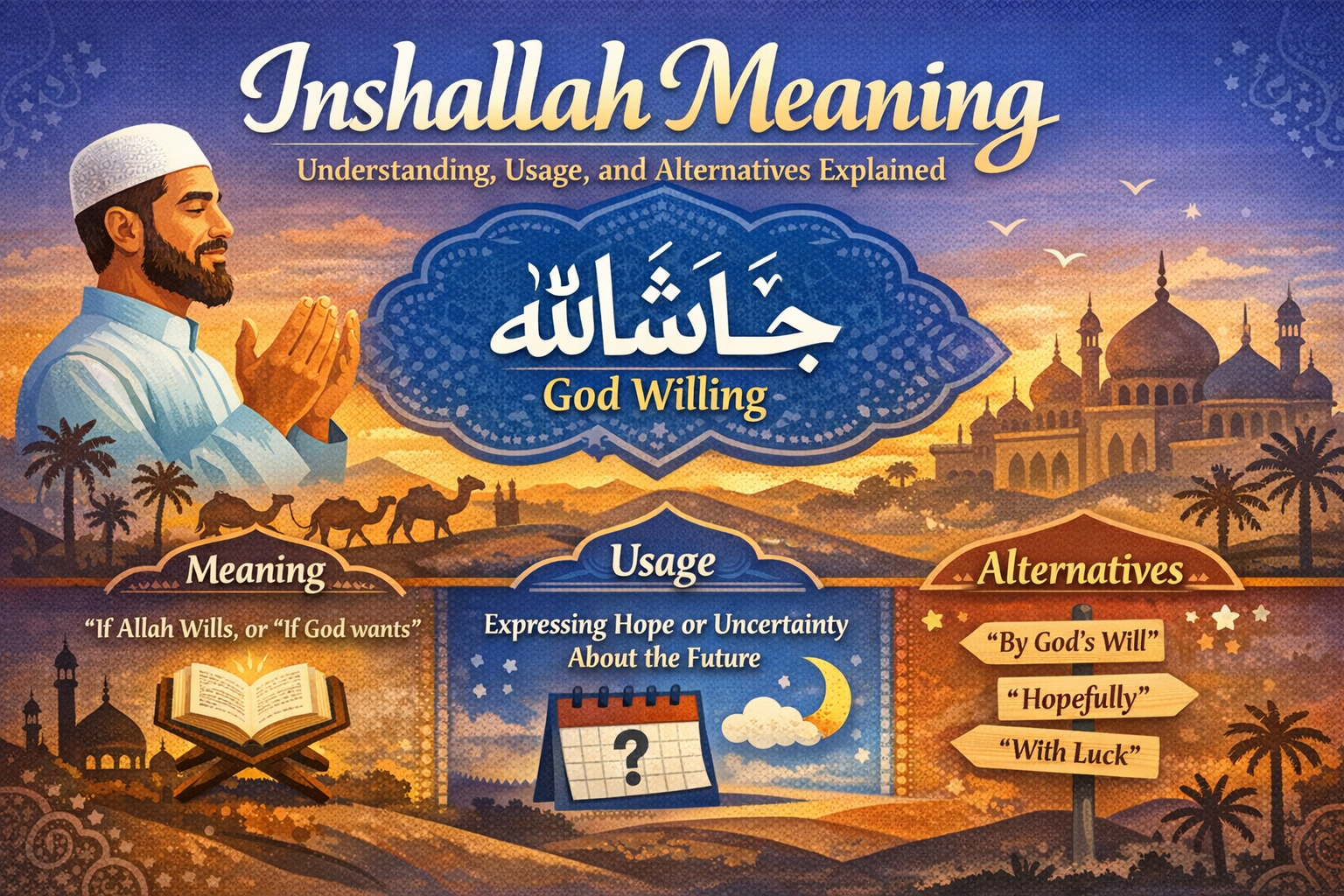
In today’s diverse American culture, phrases from many languages shape daily speech. One of the most recognized is Inshallah Meaning: Understanding, Usage, and Alternatives Explained. Even people who don’t speak Arabic often hear or use the word online, in conversations, or in media.
“Inshallah” carries spiritual weight, emotional nuance, and cultural history. It’s more than a casual phrase. For millions of Muslims in the United States, it reflects faith, humility, and trust in God’s plan. At the same time, some Americans use it lightly, sometimes without knowing its roots.
So what does it truly mean? And how has its symbolism evolved from ancient Arabia to modern American life?
Quick Answer
Inshallah Meaning: Understanding, Usage, and Alternatives Explained centers on a simple idea: “If God wills.” In the United States, it symbolizes hope, humility, and recognition that the future is not fully in human control. Globally, it reflects faith in God’s plan and acceptance of divine will.
TL;DR
• Means “If God wills” in Arabic
• Expresses hope with humility
• Deep roots in Islamic tradition
• Common among American Muslims
• Sometimes misunderstood as uncertainty
• Used in speech, texts, and social media
What Does “Inshallah” Literally Mean?
For American readers, understanding the literal meaning helps clear up confusion. The word is Arabic, but its usage reaches far beyond one region.
The Linguistic Breakdown
“Inshallah” comes from three Arabic words:
• In – “if”
• Sha’a – “wills”
• Allah – “God”
Put together, it means “If God wills.”
The word “Allah” simply means “God” in Arabic. Arab Christians and Jews also use this word when speaking Arabic. So while the phrase is most strongly associated with Islam, it is linguistically broader.
Why Literal Meaning Matters
Because the phrase refers directly to God’s will, it carries spiritual weight. It’s not meant as a joke or filler word. Instead, it reflects a worldview: humans plan, but God decides.
For many Americans who encounter the term online, this nuance is important.
Historical Origins of Inshallah
To understand its symbolism today, we must look at its roots. The phrase predates modern national identities and goes back to early Islamic history.
Ancient Arabian Context
Before Islam, Arab tribes already believed in divine forces guiding life. However, after the rise of Islam in the 7th century CE, the phrase “Inshallah” gained clear theological meaning.
The phrase appears in the Quran, the holy book of Islam. It teaches believers to say “If God wills” when speaking about future plans.
Early Islamic Teaching
The Quran instructs believers not to say, “I will do this tomorrow,” without adding “Inshallah.” This reinforces humility and submission to God.
Over time, the phrase became a daily habit among Muslims. It entered poetry, law, business, and family life.
Spread Beyond Arabia
As Islam expanded across Africa, Asia, and parts of Europe, the phrase traveled too. Today, it is spoken in countries like:
• Egypt
• Pakistan
• Indonesia
• Turkey
• Morocco
• The United States
Its meaning remained consistent, but tone and frequency vary by culture.
Symbolism of Inshallah in Islam
While the phrase is simple, its symbolism is layered. For Muslims, it reflects key theological values.
Trust in Divine Will
The phrase symbolizes surrender to God’s greater wisdom. It reminds believers that:
• Human control is limited
• The future is uncertain
• God’s plan is ultimate
• Patience is necessary
Humility Before God
Saying “Inshallah” prevents arrogance. It discourages overconfidence about future outcomes.
In Islamic theology, everything happens by God’s will. So the phrase aligns speech with belief.
Hope Without Certainty
Importantly, “Inshallah” is not fatalistic. It doesn’t mean “don’t try.” Instead, it means “try your best, but accept the result.”
What Does Inshallah Mean in America?
In the United States, the phrase has taken on additional cultural layers. America’s religious diversity shapes how it’s understood.
Among American Muslims
For Muslim Americans, the phrase carries the same religious meaning as elsewhere. It appears in:
• Family conversations
• Mosque sermons
• Community gatherings
• Social media posts
It’s a marker of identity and faith.
In Multicultural Spaces
However, non-Muslim Americans may also use the phrase. Sometimes they adopt it playfully. Sometimes they use it sincerely after learning its meaning.
Because America values freedom of religion, the phrase is generally respected in public discourse.
Emotional and Psychological Meaning
Beyond theology, the phrase has emotional symbolism. It reflects how people feel about uncertainty.
Emotional Associations
“Inshallah” often signals:
• Hope
• Patience
• Calm acceptance
• Trust in something bigger
• Release of anxiety
Psychologically, it reduces stress. When someone says “Inshallah,” they acknowledge effort but release control.
Identity and Belonging
For immigrants and second-generation Americans, the phrase connects them to heritage. It becomes a bridge between cultures.
Read More: Fett Meaning & Hiatus Meaning: Polite & Casual Alternatives
Is Inshallah Just a Polite Way to Say “Maybe”?
This is a common misunderstanding in the USA. Some interpret it as vague or noncommittal.
The Misinterpretation
In certain casual contexts, people may use “Inshallah” to soften refusal. For example, if someone says, “Will you come tomorrow?” and the answer is uncertain, the phrase might imply doubt.
Because of this, some Americans think it means “probably not.”
The Reality
Traditionally, it does not mean “no.” It means:
• I intend to try
• I cannot guarantee the outcome
• God ultimately decides
Tone and context matter. The same phrase can signal strong intention or gentle uncertainty.
Inshallah vs. Mashallah vs. Alhamdulillah
Americans often confuse these Arabic expressions. However, they have distinct meanings.
| Phrase | Meaning in the USA | Common Associations | Notes |
| Inshallah | Hope for future events | Planning, intention | Future-focused |
| Mashallah | Admiration or praise | Compliments, blessings | Present-focused |
| Alhamdulillah | Gratitude to God | Thankfulness, relief | Past or present |
Understanding these differences prevents misuse and shows respect.
Cross-Cultural and Interfaith Connections
Although strongly linked to Islam, the idea behind “Inshallah” exists in other traditions.
Christian Parallels
In Christian scripture, believers sometimes say “God willing.” The phrase appears in the New Testament in a similar way.
Jewish Tradition
In Jewish communities, people say “Im Yirtzeh Hashem,” meaning “If God wills.” The sentiment is nearly identical.
Shared Human Pattern
Across religions, acknowledging divine will reflects:
• Humility
• Acceptance
• Trust
• Spiritual awareness
So while the language differs, the archetype is universal.
Modern Usage in the Digital Age
Today, the phrase appears far beyond religious spaces.
Social Media and Texting
On platforms like Instagram or TikTok, users may write:
• “See you next week, Inshallah.”
• “Exam will go well, Inshallah.”
• “Vacation soon, Inshallah.”
It can signal sincerity or cultural pride.
Pop Culture and Music
Some artists reference the phrase in lyrics to express faith or destiny. Its presence in mainstream media increases familiarity among Americans.
Tattoos and Calligraphy
Some people choose Arabic calligraphy tattoos of “Inshallah.” However, because it’s religious, many Muslim scholars discourage tattooing sacred words.
Controversies and Misuse
Any religious phrase can be misunderstood when removed from context.
Casual or Ironic Use
Using “Inshallah” sarcastically may offend believers. Because it refers directly to God, it deserves respect.
Political Stereotypes
In some political debates, the phrase has been unfairly linked to extremism. This is inaccurate and harmful. It is a common, peaceful expression used by millions worldwide.
Cultural Appropriation Concerns
Non-Muslims can say the phrase respectfully. However, mocking or trivializing it crosses cultural boundaries.
Intent and tone matter deeply.
How the Meaning Has Shifted Over Time
Language evolves, and so does symbolism.
Traditional Meaning
Historically, the phrase was primarily religious and spoken in serious contexts.
Modern Flexibility
Today, it ranges from deeply spiritual to casual conversational use. In multicultural American settings, it sometimes blends cultural identity with everyday speech.
Generational Differences
Younger Muslims in the USA may use it in texts and memes. Older generations may reserve it for formal or religious moments.
Still, the core meaning remains intact.
Alternatives to Inshallah in English
Some Americans want to express similar ideas without Arabic phrasing.
Common English Alternatives
• “God willing”
• “Hopefully”
• “If all goes well”
• “Fingers crossed”
• “Lord willing”
Each carries a slightly different tone. “God willing” is closest in meaning.
When to Use Alternatives
In interfaith or professional settings, people may choose neutral phrases. However, among Muslim friends and family, “Inshallah” remains natural and meaningful.
FAQs
Is it respectful for non-Muslims to say Inshallah?
Yes, if used sincerely and respectfully. Avoid sarcasm or mockery. Understanding its meaning shows cultural awareness.
Does Inshallah mean something will not happen?
No. It expresses hope while acknowledging uncertainty. It does not automatically signal refusal.
Is Inshallah only used by Muslims?
It is most common among Muslims. However, Arabic-speaking Christians and Jews also use it.
Why do some people say it after every future statement?
Because Islamic teaching encourages mentioning God’s will when speaking about future plans. It becomes a habit of faith.
Can Inshallah be written in English letters?
Yes. Many people write “Inshallah,” “In sha Allah,” or “Insha’Allah.” All refer to the same phrase.
Conclusion
“Inshallah” is more than a word. It’s a window into a worldview shaped by faith, humility, and hope. For American Muslims, it expresses trust in God’s plan while still encouraging effort and responsibility.
Understanding Inshallah Meaning: Understanding, Usage, and Alternatives Explained helps bridge cultural gaps. Instead of seeing it as vague or uncertain, we can recognize its deeper symbolism: humans plan, but the future rests beyond complete control.
In a world filled with uncertainty, that message resonates far beyond any single religion.

Jason is a storyteller at Captioniy.com with a love for creativity. He writes inspiring Instagram captions and catchy one-liners that bring photos to life.