
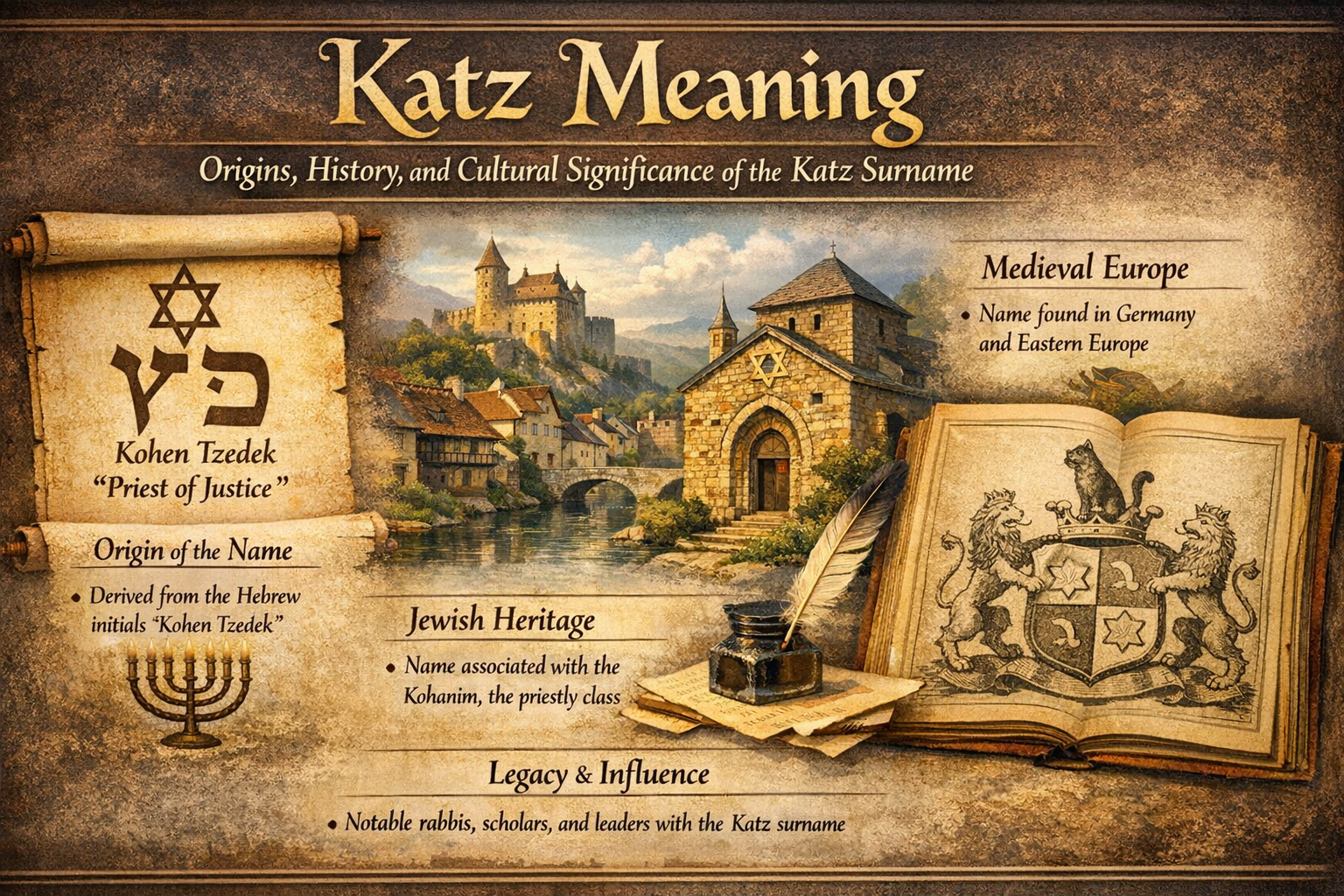
Names carry stories. Some whisper about geography. Others reveal professions, faith, or family lineage. The Katz meaning falls into the latter category. This short surname holds centuries of religious history, migration patterns, and linguistic evolution.You might encounter the name Katz in genealogy records, historical texts, academic papers, or modern pop culture. At first glance, it looks simple. However, its roots stretch deep into Jewish priestly traditions, medieval European naming systems, and migration across continents.
Understanding the meaning of Katz helps you see how one small word can connect religion, identity, and history. The story involves ancient Hebrew titles, Germanic linguistics, and the survival of cultural identity through generations.This guide explores the Katz surname meaning, origin, variations, and cultural significance in detail. Along the way, you will discover historical facts, famous individuals, migration patterns, and practical genealogy insights.
What Does Katz Mean?
The Katz meaning primarily comes from a Hebrew abbreviation: “Kohen Tzedek.”
This phrase translates to “Righteous Priest.”
Historically, the abbreviation appeared in Hebrew texts as:
כ״ץ
Jewish scholars used these letters as shorthand for Kohen Tzedek, which referred to individuals believed to descend from the priestly lineage.
The Core Definition
| Term | Language | Meaning |
| Kohen | Hebrew | Priest |
| Tzedek | Hebrew | Righteousness or justice |
| Katz | Hebrew abbreviation | Righteous priest |
This connection places the name among a group of surnames tied to Jewish priestly heritage.
Families who carried the Katz surname often belonged to the Kohanim, a group that historically served religious duties in ancient Israel.
The Hebrew Origin of Katz: Kohen Tzedek
To understand the true meaning of Katz, you need to look at ancient Jewish traditions.
The Hebrew phrase Kohen Tzedek refers to a priest known for righteousness and spiritual authority. In Jewish culture, Kohanim traditionally trace their lineage back to Aaron, the brother of Moses.
Aaron served as the first High Priest in ancient Israel according to the Hebrew Bible.
Breakdown of the Phrase
| Hebrew Word | Pronunciation | Meaning |
| Kohen | Koh-hen | Priest |
| Tzedek | Tseh-dek | Justice or righteousness |
Together they form the idea of a priest devoted to justice and holiness.
Over time, Jewish communities shortened the phrase to Katz as a convenient identifier in written records.
Why Jewish Communities Used Acronyms
Jewish naming traditions sometimes used acronym-based surnames.
These abbreviations helped preserve religious titles while fitting into different linguistic systems.
Examples include:
| Acronym | Full Phrase | Meaning |
| Katz | Kohen Tzedek | Righteous priest |
| Segal | Segan Leviyah | Assistant Levite |
| Shatz | Shaliach Tzibur | Leader of the congregation |
These surnames functioned as markers of religious roles.
Germanic Roots and Alternative Interpretations
Although the Hebrew origin dominates Jewish genealogy, the Katz surname also appears in German records.
In German, Katze means cat. Linguistically, Katz resembles the shortened version of that word.
However, the connection rarely indicates someone named after a cat. Instead, German naming traditions often relied on place names or family estates.
The Katzenelnbogen Connection
One historical link involves the medieval territory of Katzenelnbogen in Germany.
Residents who left the region sometimes shortened their surname.
For example:
| Original Surname | Shortened Form |
| Katzenelnbogen | Katz |
| Katzenstein | Katz |
| Katzenberger | Katz |
Over generations, many immigrants simplified their names when they moved across Europe or to North America.
Early Historical Records of the Katz Name
The surname appears in documents dating back centuries.
Historical records show the name emerging in Central Europe during the medieval period.
Some of the earliest mentions appear in German civic archives and Jewish community registries.
Timeline of the Katz Surname
| Period | Event |
| 1200s | Early German records mention Katz-related place names |
| 1500s | Jewish tombstones include the abbreviation “Katz” |
| 1600s | The name spreads through Central European Jewish communities |
| 1800s | Jewish families adopt fixed surnames under European law |
| 1900s | Immigration spreads the surname worldwide |
The name gained wider use during the 18th and 19th centuries, when European governments required Jewish families to adopt permanent surnames.
Why Jewish Families Adopted the Katz Surname
Jewish naming patterns changed dramatically during the late 1700s and early 1800s.
Many countries in Europe introduced laws requiring Jews to register official surnames.
Reasons the Katz Name Became Popular
Several factors explain the widespread adoption of Katz.
Religious identity preservation
Families with priestly heritage wanted surnames that reflected their lineage.
Short and memorable structure
The four-letter name proved easy to spell and pronounce in multiple languages.
Symbolic meaning
The phrase “righteous priest” carried strong spiritual significance.
Cultural continuity
Even after migration, the name helped families maintain a connection to their heritage.
These factors allowed the Katz surname to survive across continents.
Variations and Spelling Differences
Names change as they travel across languages.
The Katz surname developed several variations due to regional pronunciation and spelling conventions.
Common Variations
| Variation | Region |
| Katz | Germany and Jewish diaspora |
| Kats | Eastern Europe |
| Kac | Poland and Czech regions |
| Catz | Western Europe |
| Kaatz | Northern Germany |
Immigration officers, clerks, and translators sometimes modified names during record keeping.
As a result, different spellings often refer to the same family lineage.
Related Surnames With Similar Origins
The Katz meaning connects to a larger family of surnames linked to Jewish priestly heritage.
Many of these names derive from the Hebrew word Kohen, meaning priest.
Priesthood-Related Surnames
| Surname | Meaning |
| Cohen | Priest |
| Kohn | Variant of Cohen |
| Kagan | Derived from Kohen |
| Kahane | Another priestly form |
These names share a common cultural foundation.
They signal ancestral ties to religious service in ancient Jewish society.
Read More: IIRC Meaning: Definition, Origin, and How to Use the Acronym Correctly Online
Cultural Significance of the Katz Name
Names do more than identify individuals. They carry social meaning and historical memory.
The Katz surname reflects several cultural themes.
Symbol of Jewish Heritage
Within Jewish communities, the name suggests a connection to Kohanim traditions.
Priestly descendants historically performed specific religious functions.
For example:
- Blessing congregations during synagogue services
- Participating in ceremonial rituals
- Preserving ancient traditions
Identity Across the Jewish Diaspora
The Jewish diaspora spread communities across Europe, the Middle East, and the Americas.
Despite this geographic dispersion, surnames like Katz maintained a shared cultural thread.
Famous People With the Surname Katz
Throughout modern history, individuals named Katz have contributed to science, sports, music, and public life.
Notable Figures
| Name | Field | Achievement |
| Bernard Katz | Neuroscience | Nobel Prize in Physiology or Medicine (1970) for research on neurotransmitters |
| Elias Katz | Athletics | Olympic silver medalist in the 3000m team race (1924) |
| Steve Katz | Music | Member of the band Blood, Sweat & Tears |
| Jonathan Katz | Comedy | Creator and star of Dr. Katz, Professional Therapist |
These individuals demonstrate how the surname appears across diverse professions and cultural spaces.
Global Distribution of the Katz Surname
Migration patterns shaped the global spread of the name.
Today, you can find Katz families on multiple continents.
Major Regions Where the Name Appears
| Region | Historical Reason |
| United States | Jewish immigration in the 19th and 20th centuries |
| Israel | Strong cultural and religious connection |
| Germany | Early European surname origins |
| Eastern Europe | Ashkenazi Jewish communities |
Large Jewish migration waves during the late 1800s brought the surname to North America.
Many immigrants arrived through Ellis Island and settled in cities such as New York, Chicago, and Philadelphi
Migration Story: A Typical Katz Family Journey
Imagine a Jewish family living in Eastern Europe during the 1800s.
Political instability and economic hardship push them to leave their homeland.
They travel westward through Europe before boarding a ship to America.
At immigration checkpoints, officials record their surname as Katz.
The family eventually settles in New York City.
Over generations, their descendants become doctors, artists, teachers, and entrepreneurs.
Their surname still reflects their ancient priestly heritage.
Stories like this appear repeatedly in Jewish genealogy research.
Modern Usage of the Katz Name
The Katz meaning continues to influence modern identity.
Today, the name appears in academic research, entertainment, politics, and business.
Examples of Modern Presence
- University professors and scholars
- Technology entrepreneurs
- Writers and journalists
- Film and television creators
The name also appears frequently in genealogy databases and ancestry studies.
Many families actively research their heritage to confirm connections to the Kohanim lineage.
Genealogy and DNA Research for the Katz Family Name
Modern technology helps people explore family history in ways earlier generations could only imagine.
Steps to Trace Katz Ancestry
- Examine immigration records.
- Search synagogue archives.
- Review census documents.
- Analyze family letters and photographs.
- Use DNA ancestry tests.
Genetic testing companies now study Y-chromosome markers associated with priestly Jewish ancestry.
Many individuals with the Katz surname share similar genetic patterns connected to ancient priestly lines.
Common Misconceptions About the Katz Meaning
Like many surnames, Katz attracts myths and misunderstandings.
Misconception: Katz Means Cat
The German similarity to Katze causes confusion.
However, the Jewish origin as an abbreviation of Kohen Tzedek represents the primary meaning.
Misconception: Everyone Named Katz Is a Priest
Not all families with the surname belong to the priestly lineage.
Some adopted the name due to regional or administrative reasons.
Still, many Katz families do trace ancestry to Kohanim traditions.
Why the Katz Name Still Matters Today
The Katz meaning reflects a remarkable intersection of religion, culture, and migration.
A single word preserves:
- Ancient priestly lineage
- Medieval European history
- Jewish diaspora identity
- Modern family heritage
Few surnames capture such a broad historical journey.
When people research the Katz surname today, they uncover centuries of stories about resilience, faith, and cultural continuity.
Key Facts About the Katz Surname
| Fact | Detail |
| Origin | Hebrew and German |
| Primary Meaning | Righteous priest |
| Historical Role | Connected to Jewish priestly lineage |
| First Recorded Use | Medieval Europe |
| Global Spread | Europe, North America, Israel |
These facts reveal why the surname remains recognizable and culturally significant.
Conclusion
The Katz meaning reveals far more than a simple family name. It carries echoes of ancient religious traditions, medieval European communities, and global migration.For many families, the surname acts like a bridge between past and present.It links modern descendants to a lineage that stretches back thousands of years.Some Katz families trace their roots to the priestly descendants of Aaron. Others inherited the name through geographic or linguistic transformations. Yet every branch of the name shares one trait: a powerful connection to history.When you encounter the surname today, you see more than four letters.You see a living symbol of heritage, resilience, and cultural memory that continues to shape identities around the world.

Olivia is a creative voice at Captioniy.com. She blends modern style with expressive writing to deliver Instagram captions that feel trendy and unique.