Have you ever heard someone say “mea culpa” and paused to wonder what it really means? It sounds sophisticated, almost mysterious, but at its heart, it’s a simple admission of fault. Whether in a speech, a movie, or even social media, this phrase carries a weight that plain words like “sorry” just can’t match.
Originating from Latin and traditional Catholic prayers, mea culpa has journeyed from formal liturgy into everyday English. Today, it’s used in journalism, literature, pop culture, and even casual conversation. People use it to signal accountability, humility, or even a touch of humor, depending on context. Its versatility makes it a phrase worth understanding, whether you want to sound precise, sophisticated, or just a little dramatic.
In this article, we’ll dive deep into the meaning, history, variations, and proper usage of mea culpa. You’ll learn how to use it confidently in both formal and casual settings, discover common misconceptions, and see how it has influenced literature, media, and social media. By the end, you won’t just know what it means—you’ll know how to wield it effectively in everyday life.
What Does “Mea Culpa” Mean?
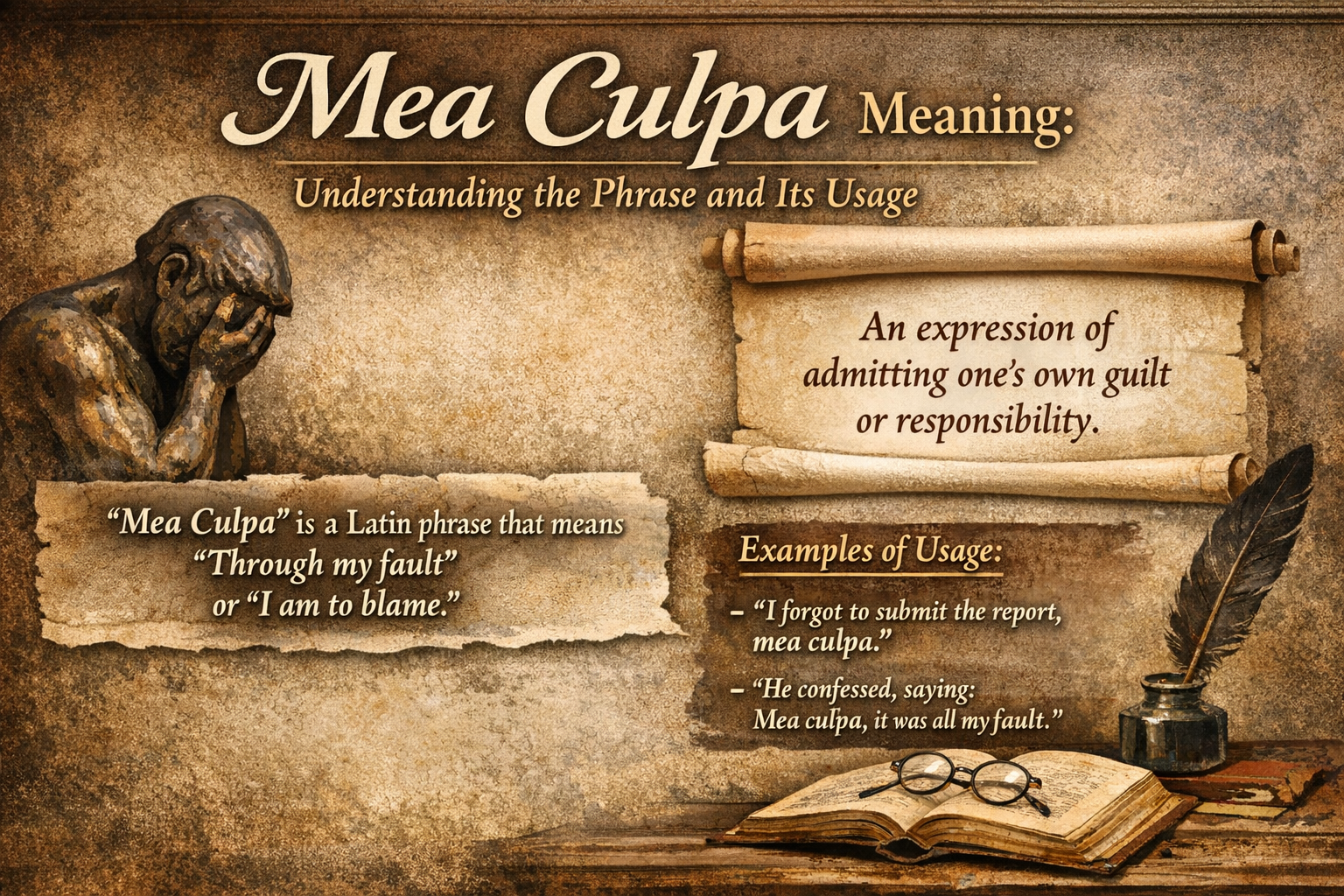
At its core, mea culpa is simple. In Latin, it literally translates to “my fault.” It’s an admission of personal responsibility for a mistake, wrongdoing, or oversight.
In modern English, its meaning has slightly evolved. People use it to:
- Acknowledge responsibility – formally or casually.
- Apologize – often more serious or self-reflective than just “sorry.”
- Convey humility or honesty – sometimes even in public statements or press releases.
Examples in sentences:
- “I forgot to submit the report on time, mea culpa.”
- “Mea culpa, I should have double-checked the figures before the presentation.”
- “He publicly admitted, mea culpa, after the software bug caused widespread errors.”
Notice how it carries more weight than a casual apology like “my bad.” Using it properly signals thoughtful acknowledgment rather than offhand regret.
Origins of “Mea Culpa”
Understanding the origin of mea culpa adds depth to its meaning.
- The phrase comes from Latin, primarily used in Christian liturgy.
- It appears in the Confiteor, a traditional Catholic prayer, recited during confession:
“Confiteor Deo omnipotenti… et tibi, fratres, quia peccavi nimis cogitatione, verbo et opere… mea culpa, mea culpa, mea maxima culpa.”
(I confess to Almighty God… and to you, my brothers, that I have sinned excessively in thought, word, and deed… through my fault, through my fault, through my most grievous fault.)
- Medieval monks and scholars extended its usage in writing and manuscripts as a formal acknowledgment of error.
Timeline of Evolution:
| Era | Usage | Context |
| 9th-12th Century | Liturgical | Recited in Catholic prayers during confession |
| 13th-16th Century | Scholarly writing | Used in manuscripts and letters to admit mistakes |
| 17th-19th Century | Literature | Appears in English and European texts as a stylistic Latin phrase |
| 20th-21st Century | Modern English | Used in journalism, social media, pop culture, and casual speech |
This timeline shows how a religious phrase gradually entered secular, cultural, and professional English usage.
Different Forms and Variations
While mea culpa is the most common form, it has variations that convey different degrees of responsibility.
| Phrase | Meaning | Example Usage |
| Mea culpa | My fault | “I missed the deadline, mea culpa.” |
| Mea maxima culpa | Through my most grievous fault | “I neglected the client’s request, mea maxima culpa.” |
| Mea culpa iterata | My repeated fault | Rare, used in literature for recurring mistakes |
Reinforced forms, like mea maxima culpa, intensify the acknowledgment.- Writers sometimes adapt the phrase humorously or idiomatically: “Mea culpa… but the dog ate my homework.”
Using the right variation depends on context, audience, and tone.
How to Use “Mea Culpa” Correctly in English
Using mea culpa incorrectly can make you sound either pretentious or insincere. Here’s how to avoid that.
Grammar & Style Tips:
- Capitalize only when starting a sentence: “Mea culpa, I forgot to call.”
- Avoid using it in every apology—it loses impact if overused.
- Pair it with context: clarify what mistake you’re acknowledging.
Contextual Guidance:
| Situation | Appropriate? | Example |
| Formal writing | ✅ | “The company issued a statement, mea culpa, regarding the product recall.” |
| Casual conversation | ✅/⚠️ | “Mea culpa, I didn’t text back.” (Okay among friends but may sound dramatic) |
| Social media | ✅ | Twitter posts often use mea culpa humorously: “Mea culpa, I ate the last cookie.” |
Mistakes to Avoid:
- Using mea culpa without actually taking responsibility.
- Replacing plain “sorry” in casual chats unnecessarily—it can seem forced.
- Overcomplicating with other Latin phrases unless your audience appreciates them.
Read More: 2222 Angel Number Meaning: The Real Message Behind Repeating 2s and What You Should Do Next
“Mea Culpa” in Popular Culture
Mea culpa has leapt from the pages of religious texts into movies, TV, music, and media. Its usage adds humor, drama, or sophistication depending on context.
Examples:
- Literature: F. Scott Fitzgerald’s works occasionally use Latin phrases to show character introspection.
- Movies: In The Godfather Part III, a character admits his mistakes with a formal Latin phrase, echoing mea culpa.
- TV Shows: Characters often use mea culpa sarcastically to lighten tense moments.
- Music & Social Media: Modern artists may use it metaphorically in lyrics or captions to signify personal mistakes.
Diagram: Spread of Mea Culpa Across Media
Religious texts → Literature → Film/TV → Music → Social Media
This shows the journey from formal religious usage to everyday cultural reference.
Why People Use Latin Phrases Like “Mea Culpa” Today
Latin phrases like mea culpa persist because they add weight, humor, or style.
Reasons for popularity:
- Gravitas: Latin conveys seriousness that plain English lacks.
- Cultural signaling: Shows education, sophistication, or literary knowledge.
- Nuance: Suggests self-awareness and reflection rather than just saying “sorry.”
- Humor: Can be used ironically or playfully.
Comparison of impact:
| Phrase | Tone | Impact |
| I’m sorry | Casual | Sincere but plain |
| My bad | Casual/friendly | Light, informal |
| Mea culpa | Formal/reflective | Sophisticated, accountable |
| Mea maxima culpa | Very serious | Strong, dramatic acknowledgment |
Using mea culpa thoughtfully signals that you truly recognize your fault, not just brushing it off.
Common Misconceptions
People often misuse mea culpa, diluting its meaning. Here are the most common mistakes:
- It’s not slang: Using it casually like “oops, mea culpa” can feel insincere.
- It’s not interchangeable with “I apologize” in every setting: Context matters.
- It’s not just for humor: While funny in memes, the original meaning carries responsibility.
Quick FAQ-Style Bullets:
- Q: Can I use mea culpa in business emails?
A: Yes, for formal apologies, e.g., admitting an error in a report. - Q: Is mea culpa overused on social media?
A: Sometimes, especially in ironic or humorous posts. Use sparingly. - Q: Can it replace “sorry” in casual conversations?
A: Only with friends who understand the nuance—it can sound dramatic otherwise.
Quick Reference Guide / Cheat Sheet
Here’s a handy table for quick recall:
| Phrase | Meaning | When to Use | Example |
| Mea culpa | My fault | General acknowledgment | “Mea culpa, I forgot to reply.” |
| Mea maxima culpa | My grievous fault | Serious or formal admission | “Mea maxima culpa, the error was mine entirely.” |
| Mea culpa iterata | My repeated fault | Literature or reflective writing | “Mea culpa iterata, I failed again.” |
Tips for Modern Use:
- Use sparingly for impact.
- Pair with context or explanation.
- Match the tone to your audience—formal, casual, humorous, or dramatic.
Conclusion
Mea culpa is a small phrase with big power. From Latin liturgy to modern media, it has endured because it signals honesty, accountability, and cultural sophistication.
Using it correctly adds nuance that plain apologies often lack. A simple “I’m sorry” might suffice, but mea culpa communicates thoughtful responsibility. Whether in writing, speech, or social media, knowing its meaning and proper context ensures your words carry weight without sounding pretentious.
Next time you make a mistake, instead of just saying “sorry,” try mea culpa. It’s more than just a phrase—it’s a statement of self-awareness and a nod to centuries of linguistic history.
FAQs
Q: What does mea culpa literally mean?
A: Mea culpa is Latin for “my fault.” It’s an admission of personal responsibility for a mistake, wrongdoing, or oversight.
Q: What is the difference between mea culpa and “I’m sorry”?
A: While both express an apology, mea culpa often carries more seriousness or sophistication. “I’m sorry” is casual, while mea culpa signals reflection and accountability.
Q: Can I use mea culpa in casual conversation?
A: Yes, but be mindful of context. Among friends, it can add humor or drama, but in professional or formal settings, it should reflect genuine responsibility.
Q: What does mea maxima culpa mean?
A: It translates to “through my most grievous fault.” This is a stronger, more formal version of mea culpa, often used in serious confessions or literature to emphasize significant responsibility.

Olivia is a creative voice at Captioniy.com. She blends modern style with expressive writing to deliver Instagram captions that feel trendy and unique.