
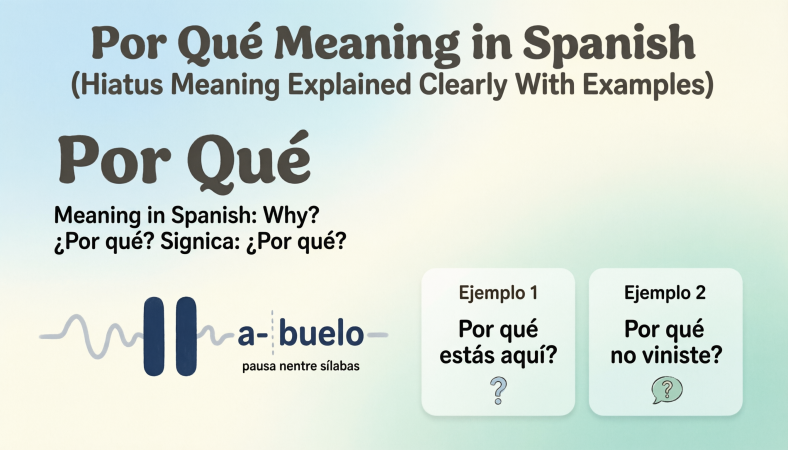
If you’ve ever come across the phrase “por qué” in Spanish and felt confused, you’re not alone. Many learners struggle to understand when to use por qué, porque, por que, and porqué.
At first glance, they all look almost the same — but their meanings and grammar rules are very different. In this guide, we’ll clearly explain the meaning of “por qué”, when to use it, and how it differs from similar forms.
We’ll also briefly explain what a hiatus means in Spanish pronunciation, since accent marks (like in qué) often relate to vowel separation rules. With simple examples and real-life sentences, you’ll finally understand how to use “por qué” correctly and confidently in everyday Spanish conversations and writing.
What Does Por Qué Mean in Spanish?
At its core, por qué means “why” or “for what reason.”
It appears in questions—direct ones like ¿Por qué…? and indirect ones like No sé por qué…
Put simply: when you want to ask why, you use por qué.
But Spanish isn’t literal. Words stack together in patterns that often don’t match English grammar. That’s why understanding how and when to use por qué matters more than just translating.
Here are the basic meanings:
- Why (asking a reason)
- ¿Por qué llegaste tarde? → Why did you arrive late?
- For what reason (a slightly more formal version)
- Necesito saber por qué ocurre esto. → I need to know why this happens.
Key Point:
Por qué always appears in questions—explicit or implied.
The Grammar Behind Por Qué (Simple Breakdown)
Let’s break this down without jargon.
Por + qué = por qué
- Por – a preposition
- Qué – an interrogative pronoun (means what or which, but here it functions as why)
Why does that matter?
Because this combination only happens when asking why. That’s why it always shows up in questions, either direct or indirect.
Direct Question Example
¿Por qué no viniste ayer?
Why didn’t you come yesterday?
Indirect Question Example
No entiendo por qué no viniste.
I don’t understand why you didn’t come.
Notice how the structure stays the same—even without question marks.
When to Use Por Qué (Real Situations)
Knowing meaning is fine. Using it correctly is better. Let’s walk through actual scenarios.
1. Asking Direct Questions
Use por qué with question marks.
- ¿Por qué estás triste? → Why are you sad?
- ¿Por qué cerraron la tienda? → Why did they close the store?
In spoken Spanish, your voice rises at the end—just like in English.
2. Asking Indirect Questions
You still use por qué, but no question marks.
- Explícame por qué sucedió eso.
(Explain to me why that happened.) - No sabemos por qué cancelaron la reunión.
(We don’t know why they canceled the meeting.)
This is where many learners slip up. Even though it isn’t in question form, you still use por qué.
3. Everyday Speech
In casual talk, people shorten or skip structures:
- ¿Y eso por qué?
(And that, why?) - Dime por qué.
(Tell me why.)
Context carries meaning.
Por Qué vs Porque (The Most Common Confusion)
This is the number one mix-up English speakers make in Spanish.
Let’s look at the difference:
| Form | Meaning | When to Use |
| por qué | why | Asking for a reason (question) |
| porque | because | Giving a reason (answer or explanation) |
Examples That Clarify
- ¿Por qué lloras?
→ Why are you crying? - Lloro porque estoy triste.
→ I’m crying because I’m sad.
Here’s a simple test:
If you can replace it with “why” in English, use por qué.
If you can replace it with “because,” use porque.
That test works almost every time.
Por Qué vs Por Que vs Porqué vs Porqué
Spanish likes to throw curveballs. Four similar forms exist, and they do mean different things.
Here’s a table to keep them straight:
| Form | Meaning | When It’s Used | Example |
| por qué | why | Asking a reason | ¿Por qué no viniste? |
| porque | because | Giving a reason | No fui porque estaba enfermo. |
| por que | for which / for that | Rare; depends on context (preposition + relative) | Este es el motivo por que luchamos. (less common form) |
| porqué | the reason (a noun) | Used as a noun meaning “the reason” | El porqué de su decisión fue claro. (The reason for their choice was clear.) |
Tip: Most learners only need to worry about por qué and porque first. The others show up more in advanced writing.
Is Por Qué Ever Used Without a Question Mark?
Yes—but only in indirect questions.
Let’s look at examples:
| Sentence | Meaning |
| No sé por qué está llorando. | I don’t know why he’s crying. |
| Explícame por qué tomaste esa decisión. | Explain why you made that decision. |
Here’s the key:
Even though there’s no question mark, the structure still expresses a question inside a statement. Spanish keeps the form por qué to show that meaning.
In English we’d use why, so this works the same way.
Common Mistakes Learners Make With Por Qué
Even advanced students slip up. Let’s tackle the biggest traps.
❌ Missing the Accent Mark
Accents change meaning in Spanish.
- Que vs Qué
- Que → that, which
- Qué → what / why (in questions)
So if you write por que instead of por qué in a question, it’s simply wrong in most contexts.
❌ Using porque in Questions
English speakers often write:
¿Porque no vienes?
That’s incorrect. You need:
¿Por qué no vienes?
Remember: Questions need why, not because.
❌ Translating Word-for-Word
Spanish doesn’t work like English. You can’t translate every question directly. Context and structure matter.
How Native Spanish Speakers Say “Why” Instead
In real conversation, people don’t always use por qué. They use alternatives that fit tone, region, and speed.
Here are some common ones:
- ¿Cómo es eso? → How come?
- ¿Y eso? → And that? (used to ask why indirectly)
- ¿Qué pasó? → What happened? (often used to ask “why” indirectly)
Regional Differences
Spanish varies between regions. For example:
- In Spain, people might say ¿Vale? after a question to soften it.
- In parts of Latin America, ¿Cierto? or ¿No? get tacked onto questions.
These don’t replace por qué, but they show how people ask questions naturally.
Pronunciation Guide: How Por Qué Actually Sounds
Pronunciation matters, especially in spoken Spanish. If you mispronounce it, people might not catch that you’re asking a question.
Here’s the quick guide:
- por → similar to “por” in English pore
- qué → sounds like “keh” with emphasis
Native rhythm:
👉 POR qué
Stress falls on the second word. In most Spanish questions, your voice rises at the end.
Quick tip: Practice saying:
¿POR qué?
Whyyy?
Notice how your voice goes up slightly at the end. That’s the natural Spanish questioning tone.
Examples of Por Qué in Real-Life Contexts
Let’s see real situations where por qué pops up.
Daily Conversation
- ¿Por qué no hiciste la tarea?
(Why didn’t you do the homework?) - ¿Por qué apagaste la luz?
(Why did you turn off the light?)
Work or School
- ¿Por qué cambió el plan?
(Why did the plan change?) - Explícame por qué usaste este método.
(Explain why you used this method.)
Emotional Questions
- ¿Por qué te sientes mal?
(Why do you feel bad?) - No entiendo por qué dejaste el proyecto.
(I don’t understand why you left the project.)
Everyday Texting
People often drop punctuation in casual text, but meaning stays the same:
- por que no respondes
(why aren’t you responding) - no se por que paso eso
(I don’t know why that happened)
Even without accents or punctuation, native speakers understand from context.
Read More: Fein Meaning (Hiatus Meaning): Real Definition, Origins, Usage, and Modern Confusion Explained
Is Por Qué Formal or Informal?
Por qué works in both formal and informal Spanish.
When It’s Formal
- Written reports
- Academic writing
- Professional emails
Example:
Necesito saber por qué hubo un retraso.
(I need to know why there was a delay.)
When It’s Informal
- Chat messages
- Conversations with friends
Example:
Oye, por qué me cuentas eso ahora?
(Hey, why are you telling me this now?)
Spanish doesn’t restrict por qué to one register. It’s universal. What changes is tone, not usage.
Quick Practice Section (Check Your Understanding)
Try these exercises. Answers are below.
Fill-in-the-Blanks
- ______ no viniste temprano?
- No sé ______ cancela la reunión.
- Dime ______ estás feliz.
Correct the Mistake
- Porque no vienes?
- Explícame porque pasó eso.
Practice Answers
- Por qué
- por qué
- por qué
Mistakes corrected:
- ❌ Porque no vienes?
✔️ ¿Por qué no vienes? - ❌ Explícame porque pasó eso.
✔️ Explícame por qué pasó eso.
Frequently Asked Questions About Por Qué
Let’s answer the questions learners ask most.
Can por qué Start a Sentence?
Yes.
Example: Por qué lo dices?
Does Punctuation Change Meaning?
Yes.
Spanish uses ¿…? to mark a question from start to finish.
Is por qué Interchangeable With Other Phrases?
Only with expressions that mean why in context, like cómo es que or a qué se debe.
Why Does Spanish Have Four Similar Forms?
Because Spanish distinguishes:
- the question form (por qué)
- the answer form (porque)
- the noun (porqué)
- a rare prepositional form (por que)
Each has its place.
Final Takeaway: How to Master Por Qué Without Overthinking
Here’s a simple rule that works:
If you’re asking why, use por qué. If you’re giving a reason, use porque.
That’s it.
When you memorize that rule, most mistakes disappear.
Then come the subtle ones—like porqué as a noun—but those are later, not first.
Conclusion
Understanding the meaning of “por qué” in Spanish becomes much easier once you break it down step by step. The key thing to remember is that “por qué” (with a space and accent mark) is used in questions, whether direct or indirect. It translates to “why” in English. The accent on qué is important because it signals that the word is interrogative.
It’s also helpful to recognize how it differs from “porque” (because), “porqué” (the reason), and “por que” (a less common structure used in specific grammatical situations). Small spelling differences can completely change the meaning of a sentence.
By practicing with examples and paying attention to accent marks, you can confidently use “por qué” in everyday conversations and writing. Mastering this small but powerful phrase will greatly improve your Spanish grammar accuracy and fluency.
FAQs
1. What does “por qué” mean in Spanish?
“Por qué” means “why” in English. It is used to ask questions.
Example: ¿Por qué estás aquí? (Why are you here?)
2. When do I use “por qué”?
You use “por qué” in direct and indirect questions.
Example (indirect): No entiendo por qué estás enojado.
3. What is the difference between “por qué” and “porque”?
- Por qué = why (question)
- Porque = because (answer/explanation)
Example:
¿Por qué lloras? — Porque estoy triste.
4. Why does “qué” have an accent mark?
The accent mark shows it is an interrogative word (question word). Without the accent, it has a different grammatical function.
5. What does “porqué” (one word with accent) mean?
“Porqué” is a noun that means “the reason.” It is usually used with an article.
Example: No entiendo el porqué de tu decisión.

Sophia adds humor and confidence to Captioniy.com. Her witty Instagram captions and bold quotes help readers make their posts stand out.