Have you ever come across the words travesty or hiatus and paused to think, “Wait, what does that really mean?” These words pop up more often than you’d imagine—whether in news articles, novels, social media posts, or even casual conversations. Understanding their meanings, origins, and proper usage not only boosts your vocabulary but also sharpens your communication skills. In this guide, we’ll break down everything about travesty meaning, hiatus meaning, and how to use them confidently in real-life contexts.
What Does “Travesty” Mean?
At its core, travesty refers to a distorted, exaggerated, or absurd version of something. When you call something a travesty, you’re usually highlighting that it’s far from fair, accurate, or true.
- Literal meaning: A parody or mockery of a serious matter.
- Figurative meaning: A complete misrepresentation or injustice.
Example in a sentence:
“The courtroom proceedings were a travesty of justice.”
Here, the word emphasizes that the trial was unfair and poorly conducted, almost mocking the concept of justice itself.
Origin of “Travesty”
The word travesty comes from the French word travesti, meaning “disguised.” Digging deeper, it traces back to the Latin transvestire, which means “to clothe across or in disguise.”
Historically, it was used to describe theatrical performances where serious subjects were mocked or parodied. Over time, the word expanded to general situations where reality is distorted or misrepresented.
Common Uses of “Travesty”
You’ll encounter travesty in several contexts:
- Legal & social commentary:
“The verdict was a travesty of justice.” - Literature & media criticism:
“The movie turned the novel into a travesty of the original story.” - Political statements:
“Ignoring climate change is a travesty against future generations.”
Misuse to avoid:
- Saying “That food is a travesty” is technically correct if exaggerated, but in casual speech, it might sound overly dramatic.
What Does “Hiatus” Mean?
Hiatus is quite different. It simply refers to a break, gap, or pause in an activity, series, or process.
- Simple meaning: A temporary pause or interruption.
- Contextual usage: Can describe work, TV shows, projects, relationships, or events.
Example in a sentence:
“The band announced a year-long hiatus after their world tour.”
This means the band is taking a temporary break, not disbanding permanently.
Origin of “Hiatus”
The word hiatus comes from the Latin hiatus, meaning “opening, gap, or chasm.” Originally, it described a literal opening or break, but over time it evolved to include metaphorical breaks in activities or time periods.
Common Uses of “Hiatus”
Hiatus is often used in:
- Professional context:
“The company took a brief hiatus from new product launches to focus on research.” - Entertainment/media:
“The TV show is on hiatus until the next season.” - Personal projects:
“She put her blog on hiatus while finishing her degree.”
Misuse to avoid:
- Using hiatus to mean “end” or “cancelation” is incorrect. A hiatus implies temporary suspension, not termination.
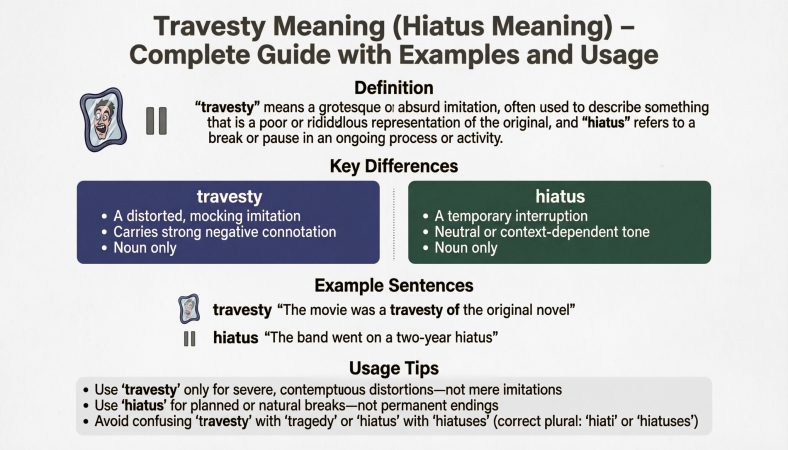
Travesty vs Hiatus – Key Differences
It’s easy to mix these words up if you’re not careful. Here’s a clear comparison:
| Aspect | Travesty | Hiatus |
| Meaning | Distorted, absurd, or unfair version of something | Pause or break in activity or sequence |
| Tone | Often negative or critical | Neutral or formal |
| Context | Legal, social, literary, media | Work, entertainment, personal projects |
| Example | “The trial was a travesty of justice.” | “The series went on hiatus for two months.” |
Key takeaway:
Confusing the two can change your message entirely. Travesty critiques or mocks, while hiatus signals a temporary pause.
How to Use “Travesty” in Sentences
Using travesty correctly can make your writing sharper and more expressive. Here are examples across different contexts:
- Everyday conversation:
“It’s a travesty that they didn’t recognize her effort.” - Academic writing:
“The experiment’s design was a travesty of scientific methodology.” - Social media commentary:
“Turning this iconic novel into a reality show was a travesty.”
Tips for usage:
- Use travesty to emphasize absurdity or injustice.
- Avoid overusing it in casual contexts—it can sound dramatic if misapplied.
Mini Quiz:
Which of the following sentences uses travesty correctly?
- “Taking a nap is a travesty.”
- “The ruling was a travesty of justice.” ✅
Read More: Mucho Gusto Meaning: The Complete Guide to Spanish Greetings and Their English Equivalents
How to Use “Hiatus” in Sentences
Hiatus is versatile and works in professional, personal, and entertainment contexts. Examples:
- Work context:
“The research team went on hiatus during the holidays.” - Media/Entertainment:
“The podcast is on hiatus until further notice.” - Personal life:
“I decided to put my social media on hiatus for mental clarity.”
Tips for usage:
- Always ensure the break is temporary.
- Pair with a timeframe when possible for clarity:
“The blog is on a six-week hiatus.”
Mini Quiz:
Fill in the blank:
“The football season went on ______ after the league suspended games.” ✅ (hiatus)
Fun Facts About Travesty and Hiatus
- Travesty:
- Originally used in theater to describe parodies of serious plays.
- Famous quote:
“Justice delayed is a travesty.” – Anonymous
- Hiatus:
- The word is commonly mispronounced as “hi-a-tus” (/haɪˈeɪtəs/), but the correct pronunciation is “high-uh-tus.”
- Many famous TV shows have gone on hiatus to build anticipation, including Stranger Things and The Witcher.
Pop Culture Examples:
- Travesty: Critics often call poorly adapted films “travesties of the original.”
- Hiatus: Popular musicians like Adele and Beyoncé have taken hiatuses between albums to focus on personal life and creativity.
Case Study: Misusing Travesty vs Hiatus
Scenario: A news article reads:
“The festival went on a travesty for two months.”
- Problem: Travesty is incorrectly used. The sentence should say:
“The festival went on a hiatus for two months.” - Why it matters: Misusing words can confuse readers and weaken credibility. Understanding subtle differences ensures precise and effective communication.
Frequently Asked Questions (FAQ)
Is “travesty” always negative?
Yes, it usually conveys something absurd, unfair, or mockingly distorted. It’s rarely neutral.
Can “hiatus” be permanent?
No. By definition, a hiatus is temporary. If an activity ends permanently, terms like “closure” or “termination” are more accurate.
Are there synonyms for “travesty” and “hiatus”?
Travesty: parody, mockery, farce, distortion.
- Hiatus: break, pause, intermission, gap.
How do I remember the difference between the two words?
- Travesty: Think “twisted reality” – it distorts or mocks.
- Hiatus: Think “holding pattern” – a temporary stop or break.
Conclusion
Mastering words like travesty and hiatus elevates your writing and communication. Travesty helps you critique or highlight injustice, while hiatus signals a pause without ending. With clear definitions, examples, and practical usage tips, you can confidently integrate both words into conversation, social media posts, and professional writing.
Next time you read a news article, a novel, or a social media update, notice how these words are used. Try crafting sentences of your own—they’re easier to remember when you put them into practice!

Sophia adds humor and confidence to Captioniy.com. Her witty Instagram captions and bold quotes help readers make their posts stand out.